A Look at Early Eighteenth-Century Fashion in Fra’ Galgario’s Portrait of a Young Gentleman
On the occasion of the recent long-term loan of Portrait of a Young Gentleman by Fra’ Galgario to the Accademia Carrara in Bergamo by the Regional Directorate of Museums of Lombardy, we have undertaken a study of the clothing and textile aspects of the work.
We would like to thank Dr Emanuela Daffra of the Regional Directorate of Museums of Lombardy and Dr Maria Cristina Rodeschini, Director of the Accademia Carrara di Bergamo, for their collaboration.
The project originated from an agreement signed in February 2021 between Fondazione Lisio and the Accademia Carrara, establishing reciprocal collaboration on scientific and cultural initiatives.Together with lecturers and colleagues from Fondazione Lisio, we examined the work from the following perspectives:
- Identification of garments and clothing accessories (visible and inferred) – by Dr Alessio Francesco Palmieri-Marinoni
- Analysis of the textile aspects (visible and inferred) – by Dr Lorenzo Pesci
- Analysis of the hairstyle and wig type – by Dr Patrizia Lia
- Analysis of arms, armour, and metalwork – by Dr Lucia Miazzo
The initiative forms part of Fondazione Lisio’s scientific activities. Through the contributions of historians of costume, textiles, and the applied arts, the Foundation aims to support art historians in the analysis and interpretation of works of art by drawing on its specialised expertise in the field of material culture studies.
Introduction
Clothing-related aspects are now recognised as indispensable tools for overcoming uncertain dating and gaps in documentary evidence. They also represent essential elements both for moving beyond traditional critical and stylistic hypotheses and for achieving the most comprehensive possible understanding of the work of art under examination.
The following historical and clothing analysis of Portrait of a Young Gentleman by Fra’ Galgario, prepared by Fondazione Arte della Seta Lisio in Florence, not only marks the recent scientific and educational collaboration with the Accademia Carrara in Bergamo but also forms part of the broader field of material culture studies. This study pursues a twofold objective: first, the analysis of the historical, clothing, and textile aspects, providing a valuable contribution to art historians in determining the historical and artistic features closely related to the portrait; second, a reflection on the importance of costume and textile history in the Bergamo area, with the aim of achieving the most complete possible interpretation of the work and, consequently, fostering productive academic debate.
Clothing Aspects in Fra’ Galgario’s Portrait of a Young Gentleman
by Alessio Francesco Palmieri-Marinoni
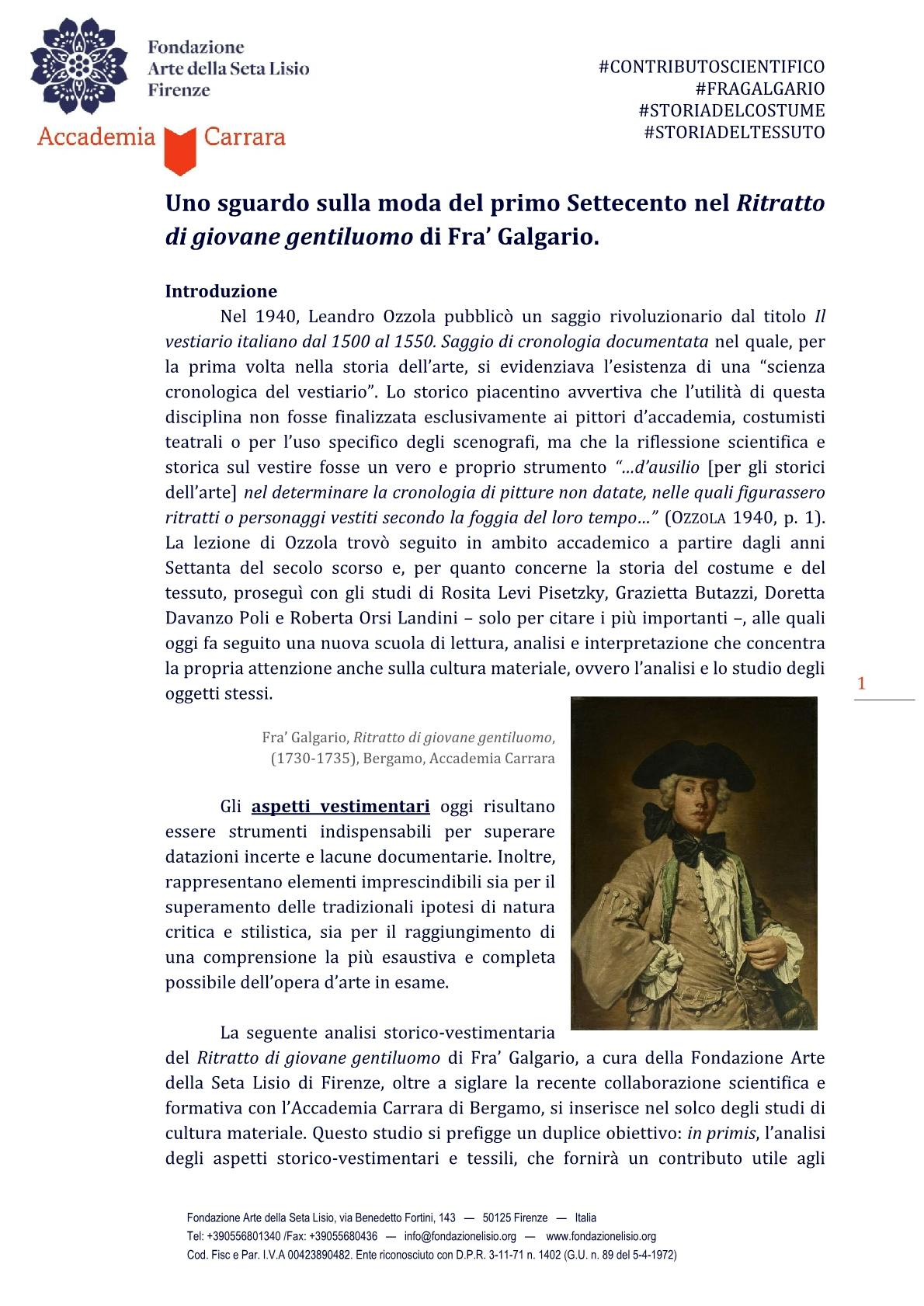
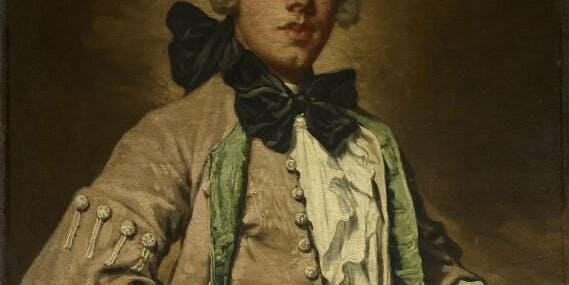
The young gentleman wears a wide day shirt with a high, almost standing collar, closed at the front by what appears to be a double row of buttons. The shirt features full sleeves gathered at the wrist by a ribbon, allowing the creation of large, soft cuffs [fig. 1], also known as agaij. In the central front section of the shirt emerges a rich jabot with flowing flounces, known as bocchette or volani. Finally, it can be observed that the shirt features simple yet elegant tailoring finishes, created through a frullino edging technique, clearly visible on the agaij and along the bocchette.
Over the day shirt, our gentleman wears an elegant camisiola, namely an under-waistcoat or waistcoat, lined and characterised by the same length as the outer garment. The camisiola features a rich and dense button arrangement, known as a bottoniera, with flat covered buttons, wide pockets closed by shaped flaps, embellished with buttonhole-stitched edged openings.
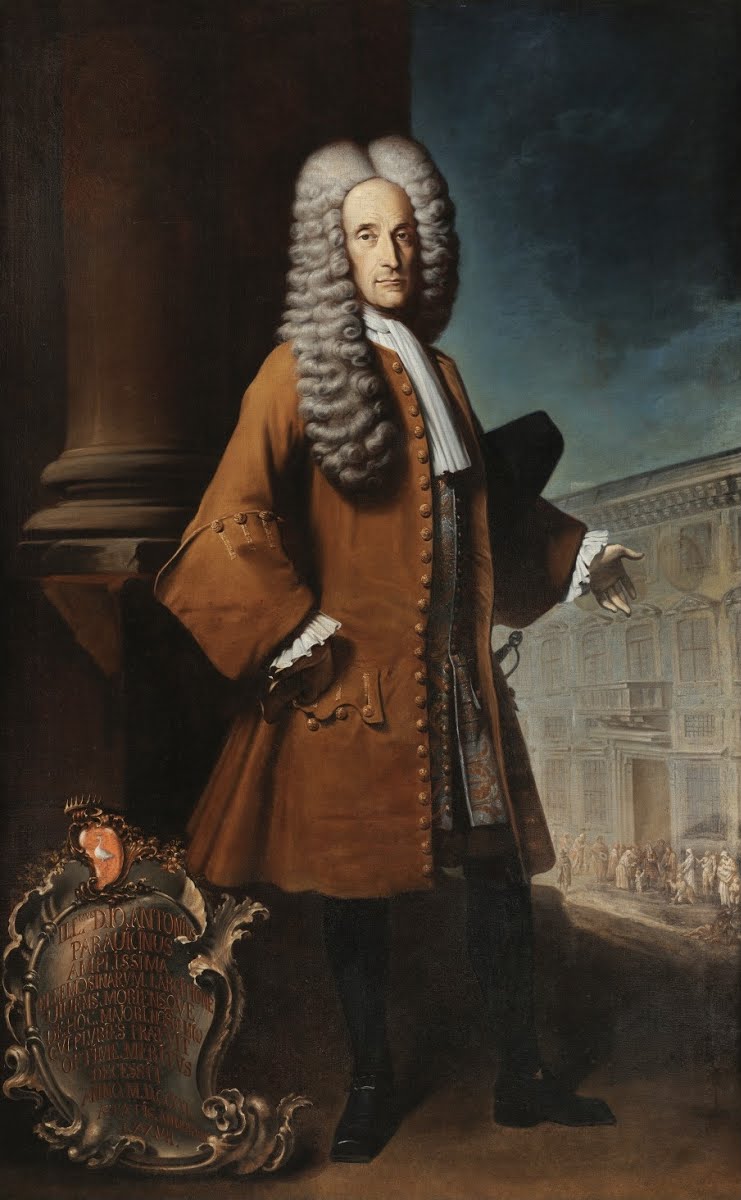
The final clothing element is the marsina or velada. The painting suggests a knee-length garment, as well as its volumes, refined lining, and, thanks to its specific tailoring construction, the typical close fit to the torso characteristic of the early second quarter of the eighteenth century. The example shows comfortable, shaped sleeves characterised by large, wide cuffs [fig. 2], sometimes simply called revers, with button fastening halfway up the arm. The dense row of buttons can be glimpsed, as well as the large wing-shaped flaps closing the pockets.
The gentleman wears the tricorne hat, also known as androsman, made of black felt, with a raised three-pointed brim, embellished with a light fur trim, presumably beaver. Our gentleman wears the so-called à l’Coudet “tupè” wig, extremely fashionable among young men up to the age of thirty in the Lombard-Venetian area, ending in a black satin bag known as catogan or dolfina, held in place by a black satin ribbon called solitaire, from the French term solitaire.
Fig. 1) Count Giacomo Carrara in the eponymous portrait by Galgario (c. 1737, Accademia Carrara, inv. 58AC00114)
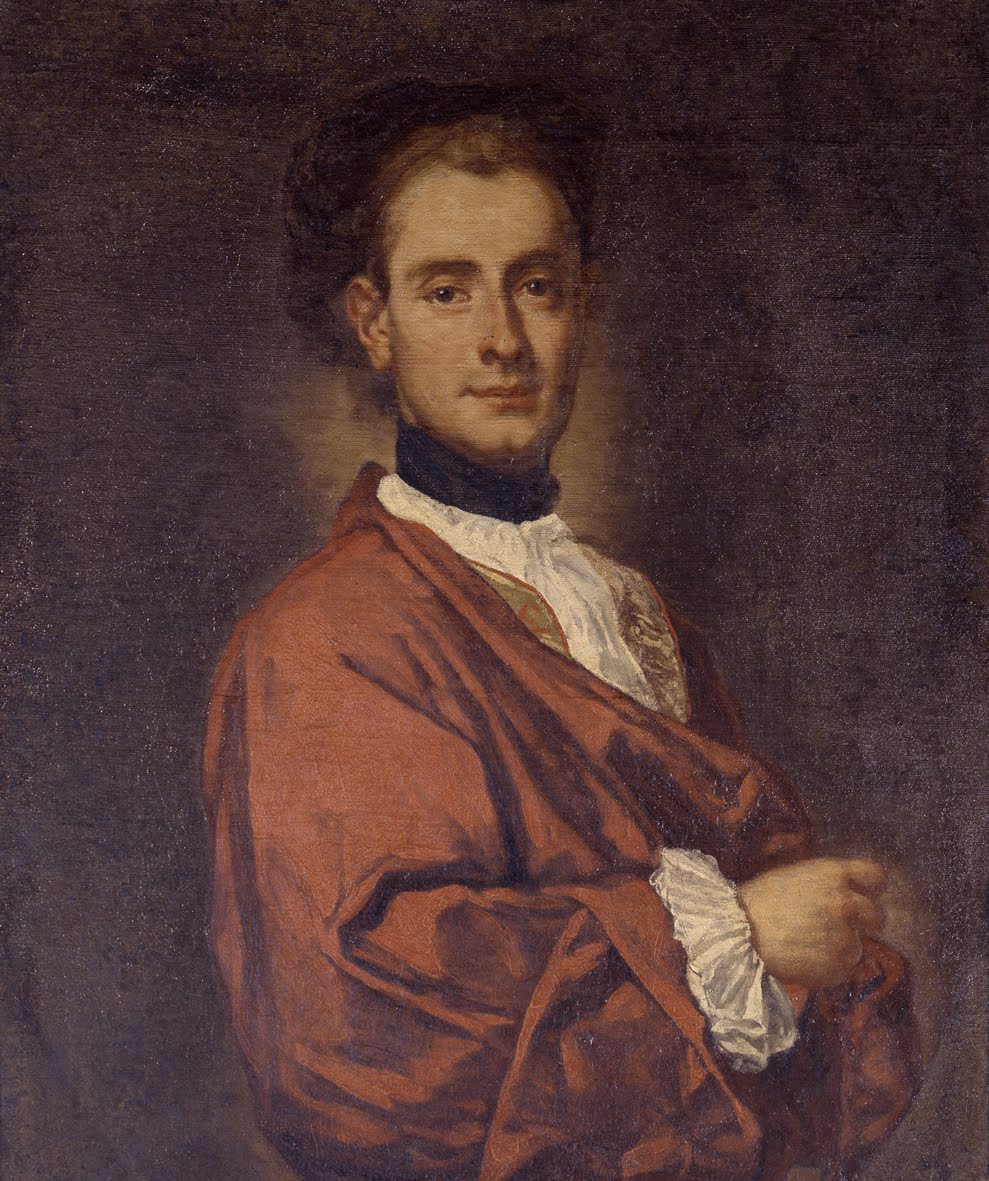
Fig. 2) Antonio Lucini, Portrait of Giovanni Antonio Parravicini, 1721, oil on canvas, Ca’ Granda, inv. Ritratti 000106
The “Textiles” of Fra’ Galgario’s Young Gentleman: a Guide Between Fashion and Individuality
by Lorenzo Pesci
In Fra’ Galgario’s Portrait of a Young Gentleman, silk is discreetly employed in the brilliant green and ivory ermesinolinings of the overcoat (velada) and waistcoat (camisiola), as well as in the creation of the indispensable accessories of elegant masculine dress: the crepau (catogan or dolfina) and the solitaire (solitario). Also made of silk are the decorative cords applied to the buttonholes of the velada and camisiola, as well as the buttons, probably made of wood or bone covered with woven threads.
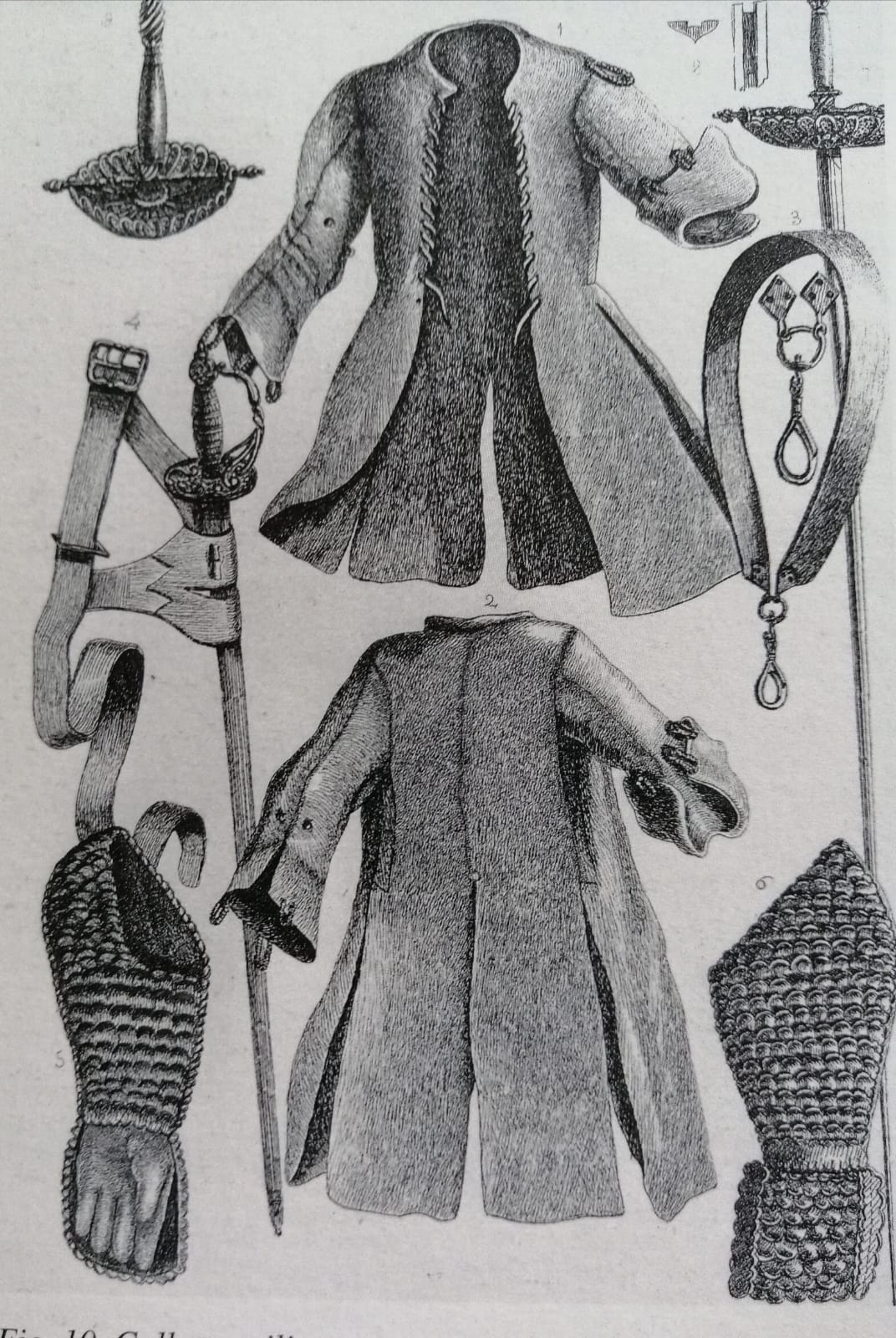
For the outer garments, the uniform colour range makes it plausible to identify the material as delicate suede leather, suggested by the characteristic light-toned “scratches”, a natural consequence of the pressure of the fingers on the soft surface of the animal hide, and by the suppleness of the folds at the flaps, button arrangement, and cuffs, which are free of padding. It is therefore not the traditional structured coat of the aristocratic silk habit, decorated with richly patterned woven motifs or embroidery, but rather the fresher and more spirited jacket in finely worked leather [fig. 3] – coordinated in material and in the “camozzino” colour with the waistcoat and breeches – derived from the military jacket [fig. 4]. This garment was assimilated into civilian clothing in cut and form when, towards the end of the seventeenth century, having lost all military associations, it became a visible item of dress, specifically suited for outdoor activities such as hunting and horse riding, the elite leisure pursuits of young men of rank.
The vitality and youthful freshness are also reflected in the choice of the pinkish hue, which, although neglected during the seventeenth century because it was considered “faded”, now appears to anticipate a fashion trend that only a few years later, from the middle of the century onwards, would increasingly enter the elegant wardrobe under the name fleur-de-pommier (“apple blossom”), emphasising through its very name the new relationship that the eighteenth century established with nature.
Fig. 3) Italy, Men’s hunting jacket, 1780–1790, light yellow suede leather, ivory linen lining, Florence, Stibbert Museum
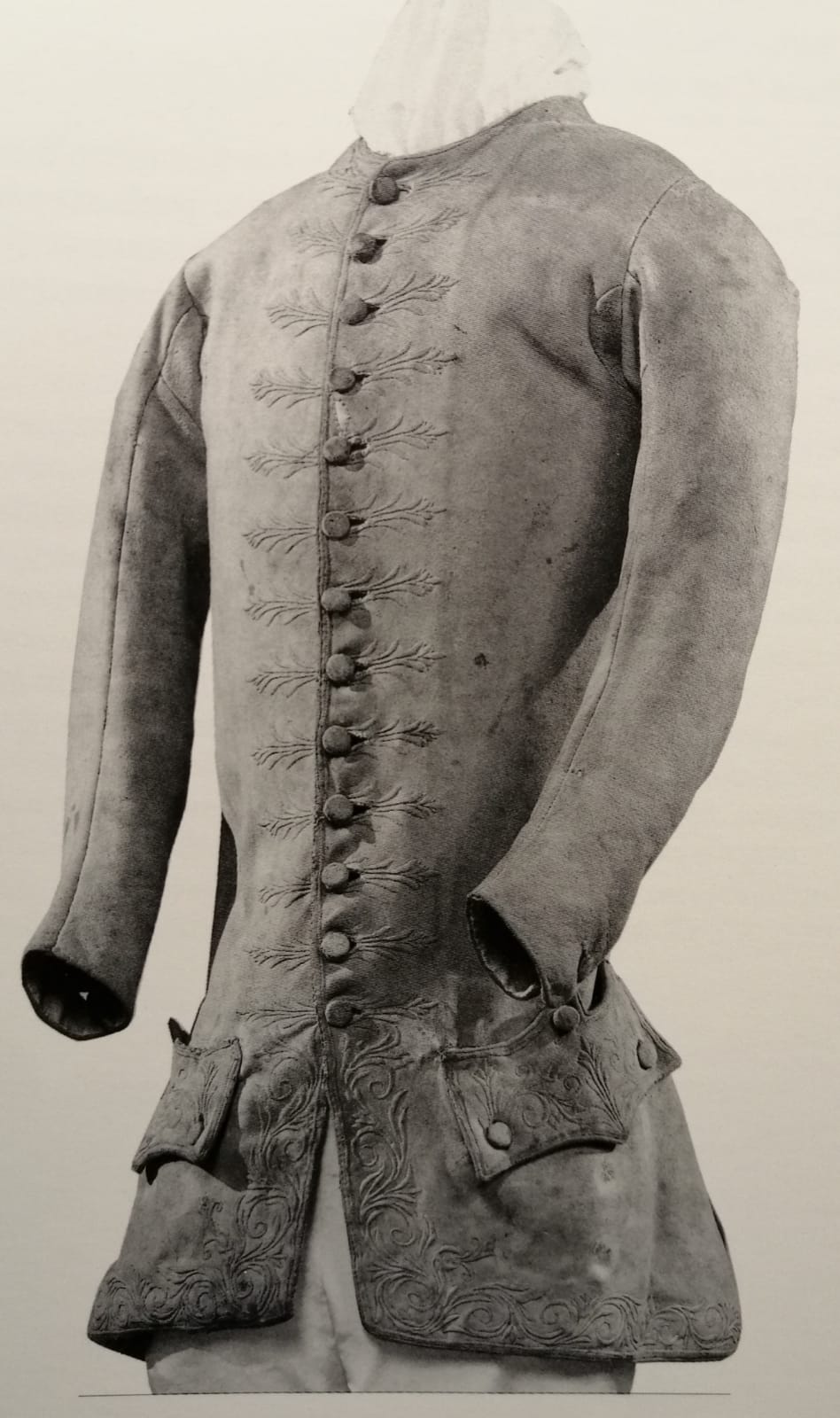
Fig. 4) Hamilton for S. Hooper, Military collar and accessories, 1785, engraving
The Politics of Appearance. The Wig in Fra’ Galgario’s Portrait of a Young Gentleman
by Patrizia Lia
The young gentleman wears a particular type of toupet (or à toupet) wig, extremely fashionable during the second quarter of the eighteenth century.
The model known as à l’Coudet, an entirely Italian version of the better-known French wig called à la Beaumont, involved curling the hair through the process of “boccolatura” using heated irons, while applying generous amounts of powder or flour dust, which could also be coloured blue or pink and heavily scented [fig. 5].
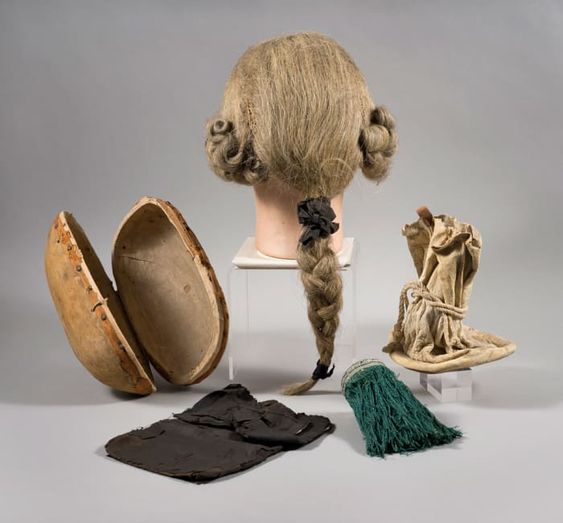
The hairstyle also includes additional elements intended to prevent any movement of the toupet, namely the black satin bag, known as catogan or dolfina, called crepeaux in France, inside which the wig’s queue was arranged. This was followed by a fabric ribbon known in French as solitaire – in Italy referred to as solitario [fig. 6]. It was a functional ribbon that, thanks to a butterfly or bow knot, helped to keep the catogan securely in place.
Fig. 5) Charles-Antoine Coypel, Portrait of Philippe Coypel, 1732, oil on canvas, Musée du Louvre, inv. RF 1968-5
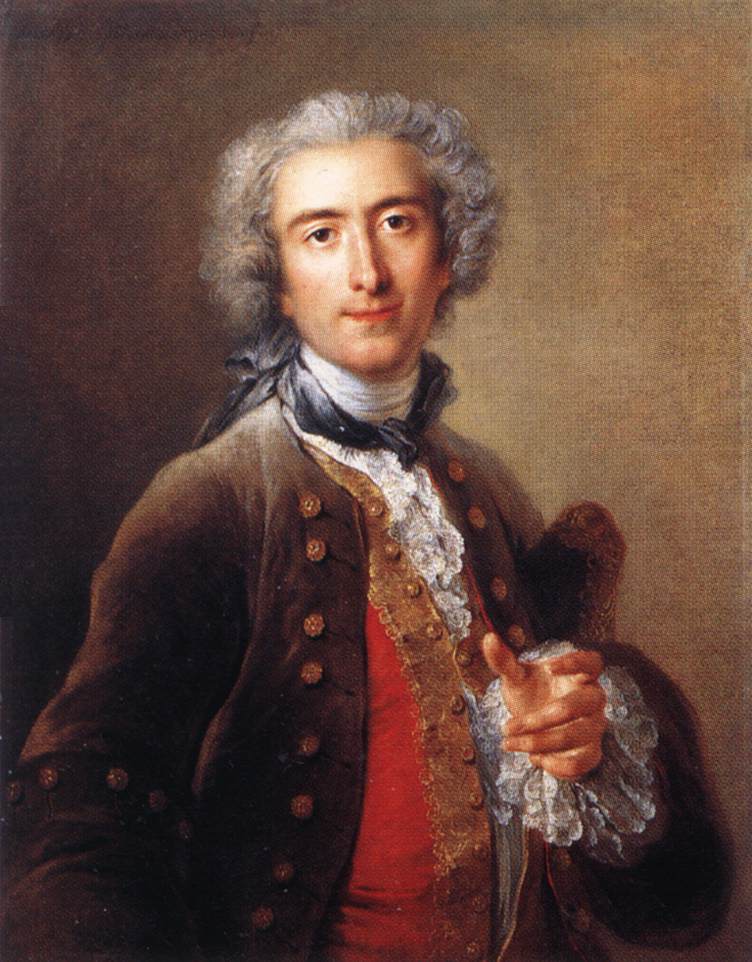
Fig. 6) European context, Men’s wig and accompanying set, 18th century, Massachusetts Historical Society
The Eighteenth Century on Stage. Observations by a Theatre Costume Designer on Fra’ Galgario’s Portrait of a Young Gentleman
by Annamaria Heinreich
For a theatre costume designer, Fra’ Galgario is undoubtedly one of the most intriguing and fascinating artists. The people portrayed offer a wide range of characters, allowing us to wonder – almost playfully – which theatrical role and character could be associated with each individual portrait, and first and foremost with the Portrait of a Young Gentleman.
If a costume designer were to recreate this garment for the stage, they would not simply have to consider which fabric might be the most suitable or which lining would be the most appropriate for making a specific outfit such as the one depicted in the portrait; above all, the costume designer would have to reflect on the tailoring structure of the justaucorps(marsina or velada), without forgetting that it would be essential to give the garment enough comfort and wearability to allow the performer on stage to move, act, sing, or dance with ease.
The study of Fra’ Galgario’s portraits is undoubtedly among the most intriguing and fascinating: every face tells a story, every garment reveals endless details. In the field of theatre costume design, Galgario is unquestionably a great source of inspiration and stimulus for us artisans of stage costume.
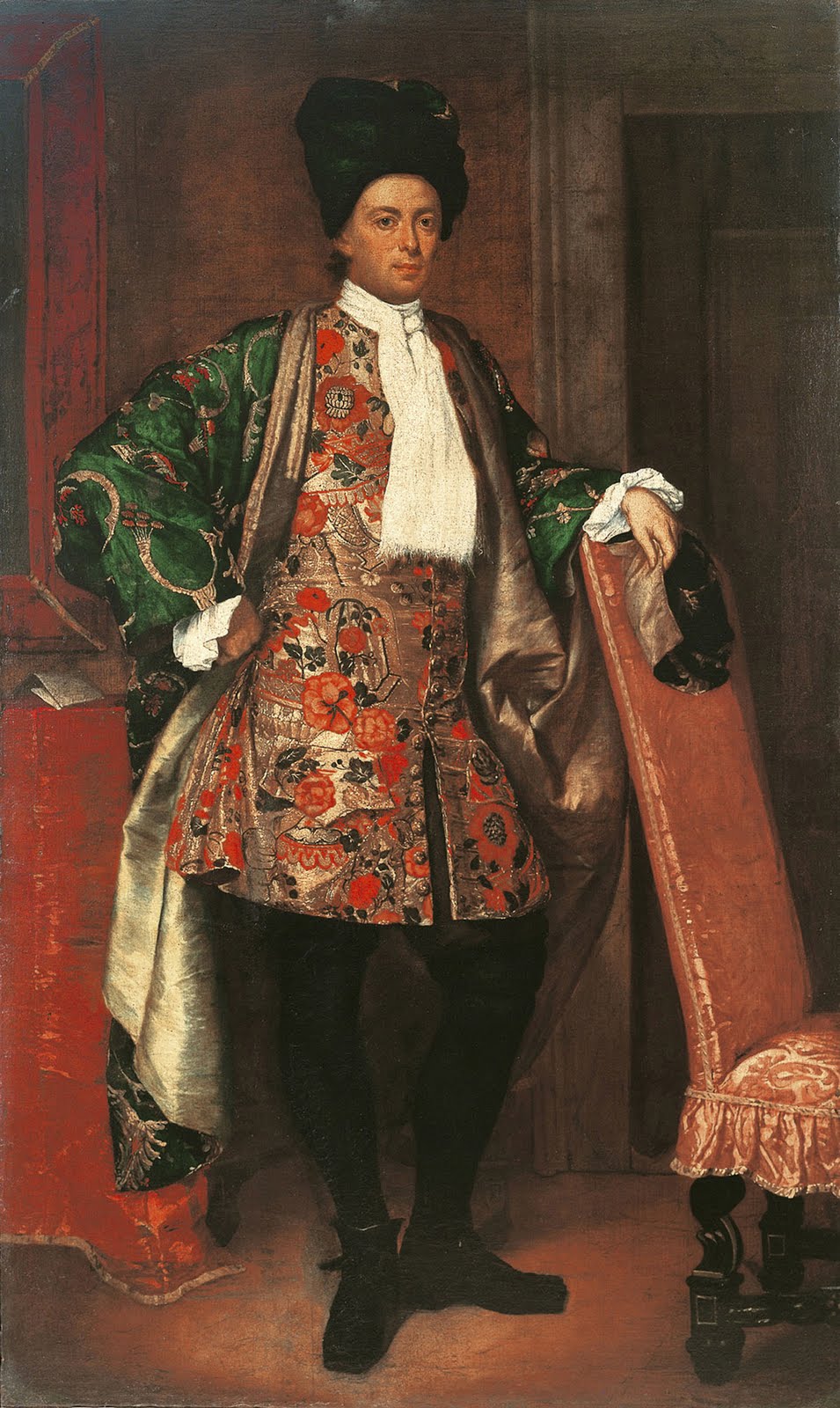
My first encounter with Fra’ Galgario occurred when I was asked to create the costumes for the opera La Dori, ovvero lo schiavo regio (1657) [fig. 6] by the composer Pier Antonio Cesti. For a conceptual choice, I preferred to use the Baroque period as a point of reflection, interpreting it freely without imposing a strict chronological and stylistic framework on the costumes of the characters in this semi-serious opera. For the character of Artaserse, uncle of Oronte and regent, in Cesti’s opera, I drew inspiration from the Portrait of Count Giovanni Battista Vailetti (c. 1710, Gallerie dell’Accademia, inv. Cat.778) [fig. 7]. In Fra’ Galgario’s painting, one can perceive the contamination of worlds and fashions from distant countries, masterfully expressed in the depiction of the fabrics of the oriental-inspired garment, characteristics that can be associated with the character himself in an opera set between Persia and Egypt.
Returning to our painting, for a theatre costume designer, Fra’ Galgario’s art is an essential testimony for an accurate reflection on an era that would establish the foundations leading to the terror of the guillotine, as well as to profound political and social changes. For those passionate about the History of Costume and Fashion, and for those who professionally create theatrical costumes, the study of his pictorial production is fundamental not only for personal enrichment but also, last but not least, for an invaluable aesthetic enjoyment.
Fig. 6) Character of Artaserse from the opera La Dori by Pietro Antonio Cesti (1657), Innsbruck Festival of Early Music, 2019, costumes by Annamaria Heinreich
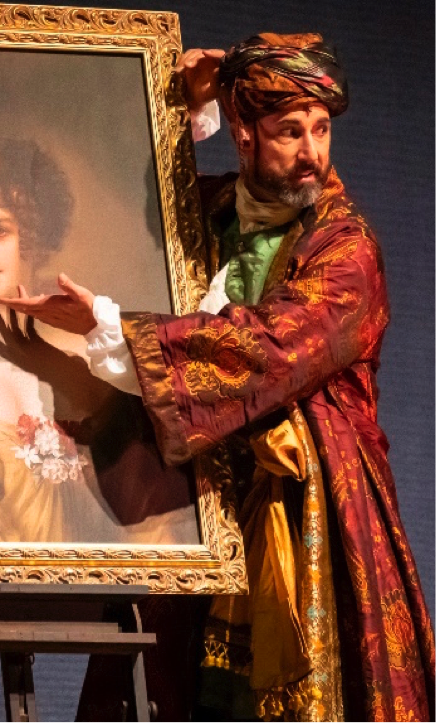
Fig. 7) Vittore Ghislandi, known as Fra’ Galgario, Portrait of Count Giovanni Battista Vailetti, oil on canvas, c. 1710, Gallerie dell’Accademia, Venice, inv. 778
Fra’ Galgario’s Portrait of a Young Gentleman. An Antecedent of Contemporary Men’s Fashion Today
by Giulia Paolina Secco Suardo
Fra’ Galgario’s work presents the portrait of a young Lombard nobleman dressed according to the canons of fashion at the turn of the first and second quarters of the eighteenth century, a period in which masculine clothing still preserved, for a short time, those symbols and values that would be definitively lost only half a century later, while nevertheless maintaining elements that have remained almost unchanged until today. But what can a fashion designer today interpret from a portrait such as Fra’ Galgario’s?
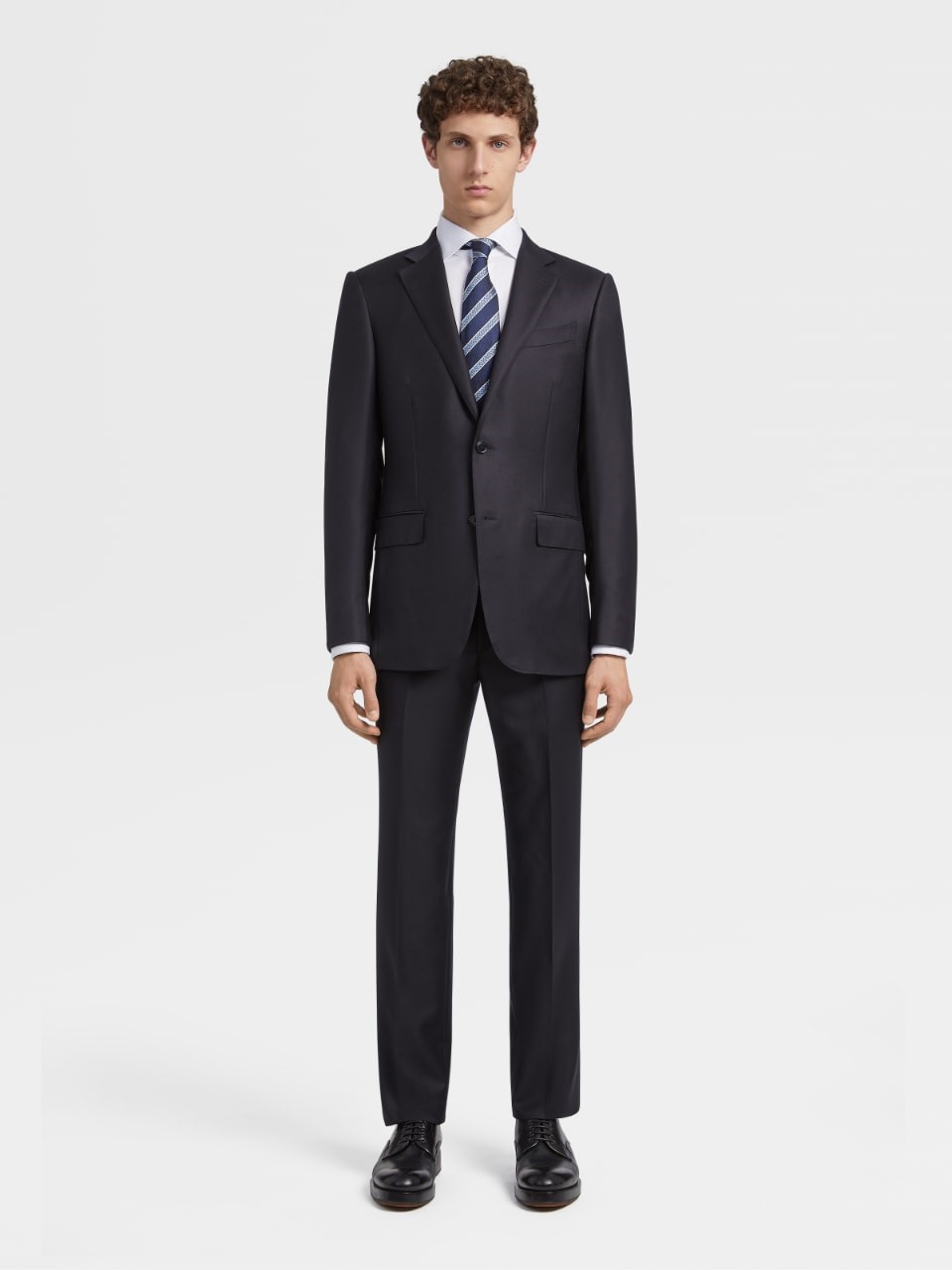
From the beginning of the nineteenth century, the codes of men’s clothing began to change, as did the need to express seriousness, stability, and power, finding their solution in the spread of the suit, which was far less ostentatious, decorated, and voluminous compared to the formal male attire of previous centuries. During this historical period, clothing became slightly more formal, with more sober colours. A more significant transformation began to emerge around the middle of the nineteenth century, when the three-piece suit (jacket, waistcoat, trousers) appeared [fig. 8], a period in which formal menswear became distinctly more restrained in both lines and tones.
We can observe the continuity between the waistcoat (sottomarsina), the coat (marsina) and the breeches (culotte), established precisely at the beginning of the eighteenth century with the spread of the Habit à la Française, the ancestor of the formal men’s suit, which would become the uniform of the respectable bourgeoisie throughout the nineteenth century.
There is a strong connection between the earliest examples of the men’s suit and contemporary stylistic proposals. Analysing two of the most influential Italian designers, Ermenegildo Zegna and Prada [fig. 9], we can observe how formal menswear has remained almost unchanged for nearly two centuries.
Men’s clothing no longer serves as an element of display for its own sake. With the end of the eighteenth century, the men’s suit became a strict uniform that, from the nineteenth century onwards, underwent only small variations within rigid boundaries. This phenomenon is completely opposite to the evolution of women’s fashion.
Fra’ Galgario shows us a young man who could still display his status through clothing. After him, the codes would change, and more than two centuries would begin in which sobriety became an essential quality for masculine representation. With the end of the eighteenth century, Western society began to identify itself with the sober men’s suit in order to rediscover seriousness, status, and the wealth associated with masculinity.
The colour palette became significantly reduced: for men’s formal clothing, greys and dark blues remained, with timid attempts at beige mid-tones. However, in formal contexts, men no longer had access to the bright colours that, at the time of the portrayed gentleman, were still part of masculine conventions, along with the use of luxurious materials and decorations.
I also reflect on the difference in the attribution of symbolic value to clothing between the period of the portrait and the modern and contemporary era. Each historical period has had its own sartorial codes, imposed by fashion, law, or society.
If, at the time of the portrait, every element, material, decoration, or colour had a precise meaning and expressed a specific concept of value, in the modern and contemporary era the value of a garment is instead attributed primarily to the label it bears, thus losing the true and intrinsic value of the garment itself.
Fig. 8) Men’s suit, 1800
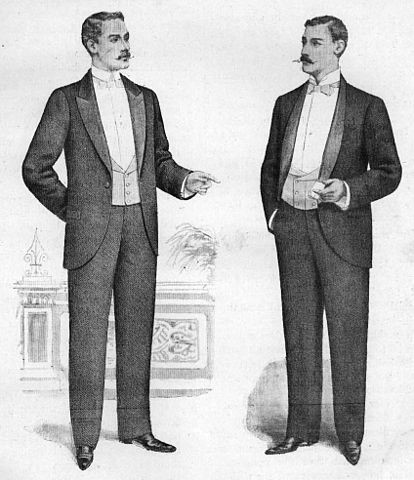
Fig. 9) Zegna, men’s suit, 2021
Conclusion
Based on the analysis of the clothing, textile aspects, and accessories, it is possible to state that Fra’ Galgario’s Portrait of a Young Gentleman depicts a young member of the nobility between the ages of 25 and 30.
The young man portrayed is dressed according to the fashion of the second quarter of the eighteenth century, within a chronological range attributable to the period between 1720 and 1730. His clothing and accessories reveal a distinctly Venetian influence, combined with elements of clear French and Milanese origin. These characteristics reflect a territory such as Bergamo, which was particularly receptive to the cultural influences and exchanges of the neighbouring regions.
Glossary
Orlatura a frullino: a very fine hem obtained by rolling the edge of the fabric and securing it with almost invisible stitches.
Paramano: a large cuff or turned-back section, more or less fitted to the sleeve, which can be fastened with buttons or other decorative fastening systems.
Ermesino: a lightweight silk fabric with a taffeta weave.
Velluto unito: a fabric whose surface is completely covered with pile tufts, obtained from an additional warp (pile warp) which, during weaving, is raised by special grooved wires through which a blade is passed to cut the pile.